Thursday, September 8, 2011

Agriculture: Home of Improvements

GMOs
Dr. Nina V. Fedoroff makes these cases and substantiates them in her New York Times article, "Genetically Engineered Food For All" in favor of Genetically Modified Organisms as food:
  • "New molecular methods that add or modify genes can protect plants from diseases and pests and improve crops in ways that are both more environmentally benign and beyond the capability of older methods."
  • "Myths about the dire effects of genetically modified foods on health and the environment abound, but they have not held up to scientific scrutiny."
  • "The European Union has spent more than $425 million studying the safety of genetically modified crops over the past 25 years. Its recent, lengthy report on the matter can be summarized in one sentence: Crop modification by molecular methods is no more dangerous than crop modification by other methods."
  • "The process for approving these crops has become so costly and burdensome that it is choking off innovation."
I'm looking forward to possibly an elimination of pesticide residues thanks to GMO use (Pesticides are already present at no more than trace amounts which the EPA, FDA, and USDA deem safe -- see post, "Organic Or Not).

A Letter to the Editor challenging the above asks "If these foods are safe, why the huge lobbying effort to deny the buying public information about which foods are modified? How about a simple label informing the consumers?" I can appreciate his point. I can also appreciate the lobbying efforts, given that the labeling of milk and meat products with "No Artificial Hormones" has caused this whole national scare against hormones. The scientific community, even decade after decade of research, still cannot get through to people that there is NO difference in hormone levels of milk or meat between animals given or not given implants. Labeling can create unnecessary scares, because people, by nature, are biased in thinking that unmodified food is better than scientific innovation. We're uncomfortable with novelty, and face it, we won't go look up the facts.

Hormone Regulation

A common question regarding hormone implants in beef cattle is: Why does it make sense to castrate the animals and then go back and give them androgynous hormones again? Here are some facts supporting castration and hormone implantation:

Estrogen in bull meat is equal to that of estrogen in cow meat at 1st trimester of pregnancy. Testosterone in bull meat is over 30x that in both non-implanted steer meat and implanted steer meat, given that beef from implanted and non-implanted steers contain insignificantly different levels of testosterone.

Testosterone levels in meat:
0.34–0.73 mg/kg for bulls
0.069 mg/kg in muscle tissue from heifers
0.01–0.14 mg/kg detected in muscle from steers, both implanted and non-implanted.
Thanks to modern practices such as castration and implantation (i.e., no bull meat), we have more beef produced per animal, we have a more tender product, and finally, we have less hormone exposure to estrogen and testosterone in beef.

Sources:
Human Safety of Hormone Implants Used to Promote Growth in Cattle
Fritsche and Steinhart, 1998
Hendricks et al., 1983

So...what do you Think?

Tuesday, August 30, 2011

Feedlot, Rediscovered.

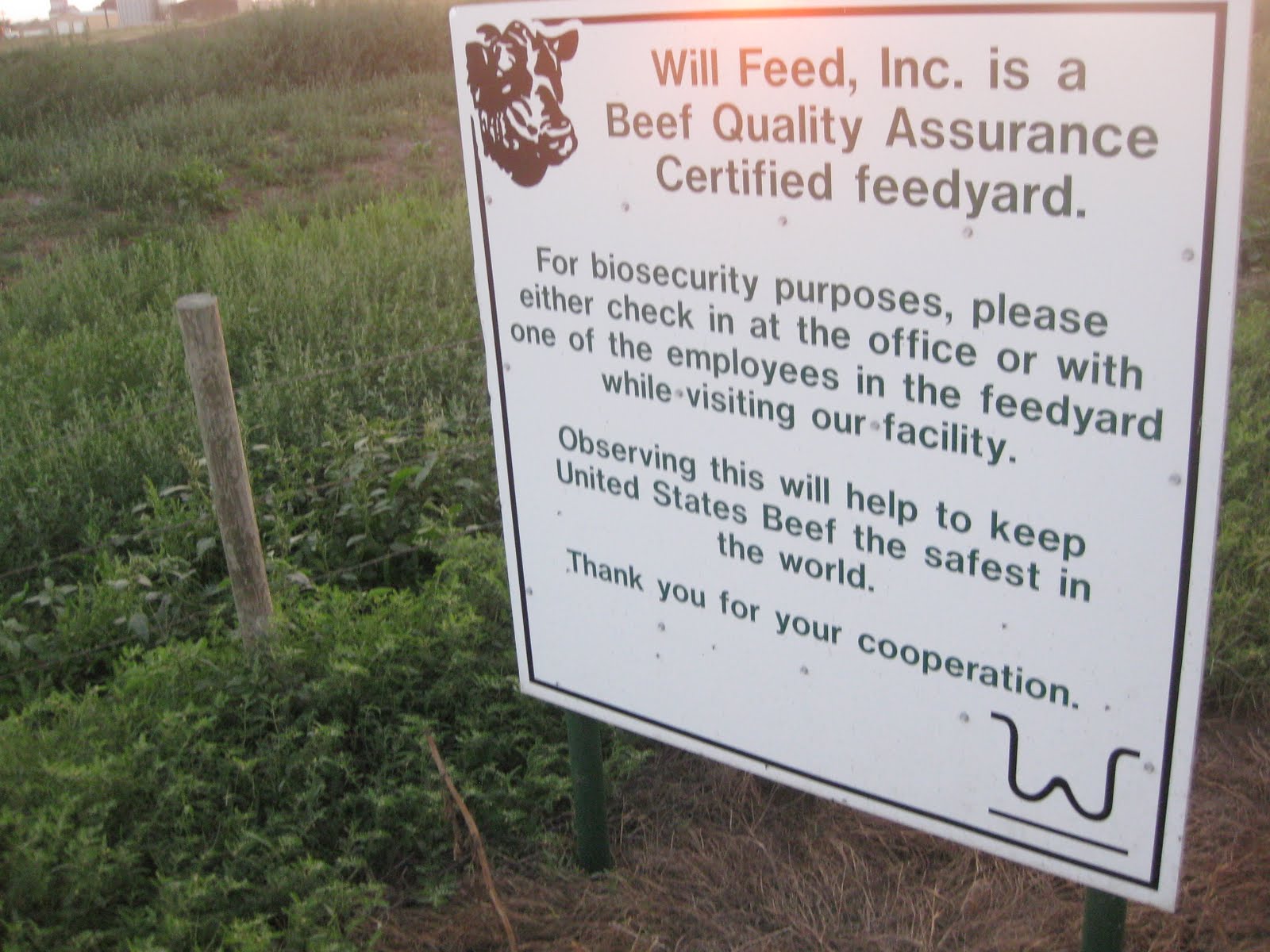
Will Feed, Inc. (Cozad, NE)
August 24, 2012


We were the only ones up at 6. The sun still tucked itself below the horizon while cattle crouched low on folded legs. Anne and I cruised up and down the alleys of the 3,000 -head feed yard in her truck to “read bunks”. This was her routine for determining from yesterday’s leftovers how much cattle should be fed today. After a meeting with the foreman about the feeding instructions, we returned to the alleyway and were greeted by weanling calves at their gate. These calves were beginning their first full day at the yard. It was time for their morning exercise and training. Anne flushed them away from the gate with a Shhhh and waving arms to send them back into their pen and have them exit in a wide circle back through the gate. She zigzagged behind them, reminding questioning ears and curious eyes where they were to go. The calves obediently, though sleepily, walked forward and away. They occasionally looked over their shoulders and wondered if they were heading the right direction. Anne encouraged them on to the back of a holding pen with her presence only, and held her arms straight out from her sides to have them “park” there. 
When they succeeded in following her directions, she moved to one side of the narrow pen and folded her arms behind her back. She began to slowly walk forward against the direction the cattle faced, and the cattle trotted past her. To slow them down, she slowed her pace. To stop them, she stopped or walked alongside them in the same direction they faced. A bovine’s “tipping point” is right at their shoulder. If you want them to walk forward, you stay behind their shoulder; stop, you stay at their shoulder; change directions, you come in front of their shoulder. After their exercise and training was complete and their behavior became more organized and collected, the calves were sent through the tub, the snake, the chute, and the squeeze to receive their new identification ear tags and vaccinations. 
After toughing out ear piercings and shots, these calves were ready to go home to their pen! Just as I’m sure they’d hoped, there was fresh prairie hay sprinkled with a little feed waiting for them in their bunks. They formed a neat line without a sound. I wish young people could do what young cattle can!
Notice that each animal gets about 300 square feet in every pen. You always see cattle crowded up together in feedlot pens leaving plenty of open space because it’s their natural herd behavior to stay close, especially if food is involved! Also, according to Beef Quality Assurance standards, feed yard pens must be kept free of mud. If water doesn’t drain properly, a skid steer must come and remove the mud. The “hills” in each pen allow a dry space for cattle to congregate in case of heavy rains, so that excess moisture can drain away from them. The entire yard has to slope down toward a water collection ditch that empties into a holding lagoon. Liquids, rich in nitrogen and phosphorus, are pumped onto adjoining crop fields.

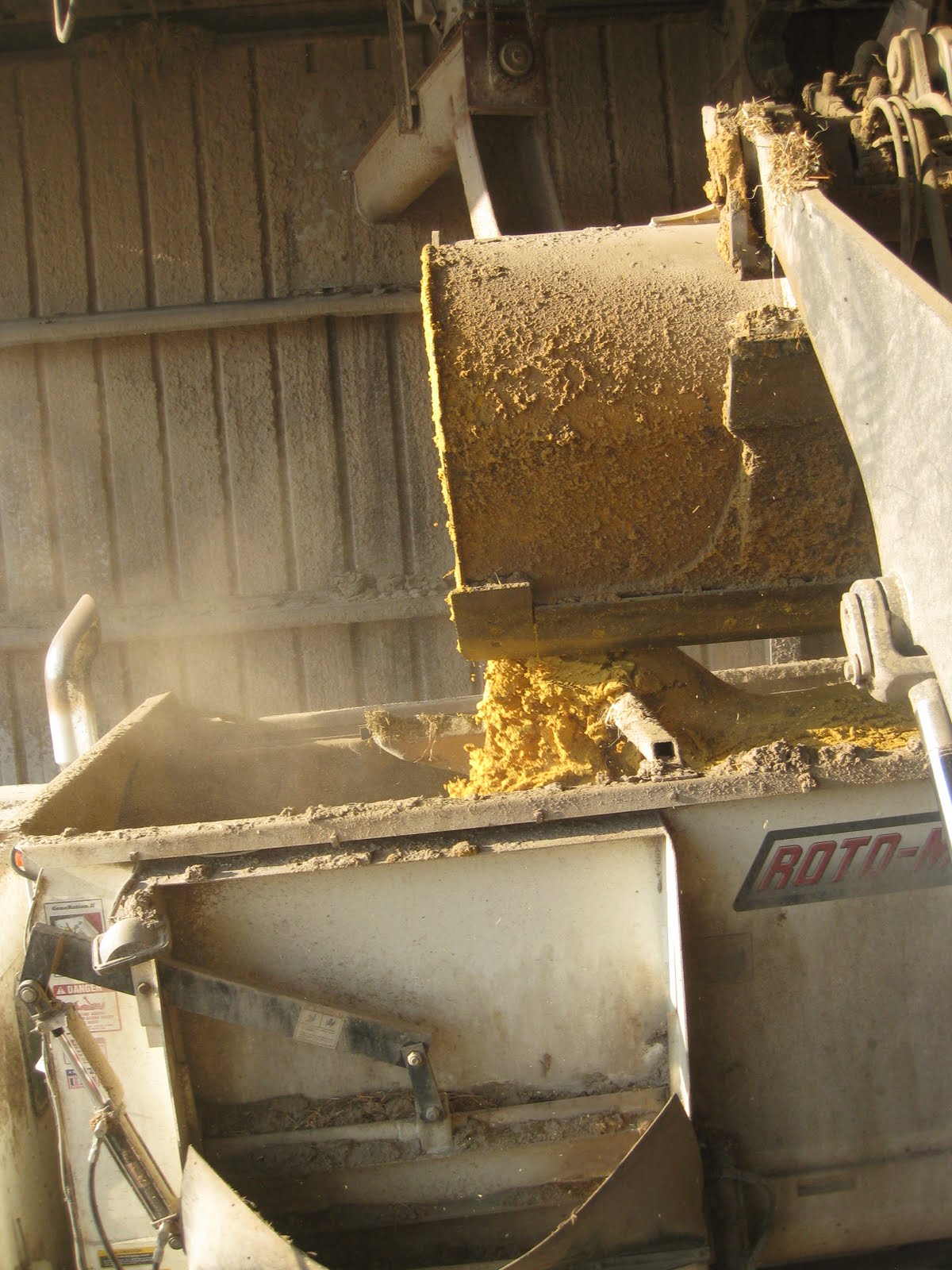
Throughout the morning, the foreman was busy making the day’s rations. Weanlings eat mostly hay for a week, and then the cattle start out on a mix of less than 15% corn, 50% distillers' grains, and 30% hay with some vitamin and mineral supplements. They progress all the way, very gradually over the course of 6 months or more, to a mix of 30% corn, 60% distillers' grains, and about 8% hay, straw, and corn stocks plus some supplement. Shocked to hear that there’s not a lot of corn in the diet? Read this article by BEEF magazine about transitioning away from corn.
They are fed twice a day, precisely the right amount so just a few scraps remain in the bunks by morning: not wastefully so they leave too much behind, and not too meagerly, either. The first night I arrived at Will Feed, I saw Anne and her workers ship cattle out. Three cattle semi-trailers headed for National Beef in Dodge City, KS picked up over a hundred finished cattle, well-rounded and readied for harvest. Look at how big they are compared to the new calves!
I discovered that the relationship people have with cattle at a feedlot can be a lot more intimate than at a cow-calf ranch. Cattle are far more dependent on people in that setting. If Anne or any of her three workers gets sick, sleeps in, or takes the day off, it directly affects the cattle. They can’t find their own food. They can only wait for it. If any steer or heifer walks with just the slightest limp, has eyes that squint just a little too much, or holds their head a little low, the cowboy who rides in pens every day or Anne who exercises the animals every day will notice it and attend to it. Out on the range, some cattlemen go days without seeing the same cow or calf.
The attention to cattle in a feedlot is much more acute. Stressed, sick, depressed, lazy, etc. cattle do not grow good beef. Cattle that have been given hormones or antibiotics improperly will also not grow good beef. Anne believes “We need to set calves up for success.” For the ongoing story of Anne and the animals she cares for, see her blog, Feed Yard Foodie. Anne won Beef Quality Assurance Producer of the Year in 2009, and this year her feedlot is being nationally recognized by Certified Angus Beef. To support her and the Beef Quality Assurance program that guides animal care for the industry, look into what BQA stands for, ask your local producers to get certified, and put some beef on your plate this week!

Hopefully more personal accounts like mine and like Anne's on her blog will serve to reclaim the Power Steer from Michael Pollan and the rest of us who lost confidence in the beef industry. What do you Think?

Thursday, August 25, 2011

In Nebraska with Feed Yard Foodie!

I am currently spending the week at Will Feed feedlot in Willow Island, Nebraska! For more information about Will Feed and the amazing story of its primary operator, Anne Burkholder, please visit her blog, Feed Yard Foodie. I'll tell you all about it next week, but until then...we've got cows to feed! Back to work!


Thursday, August 18, 2011

Flour or Corn Tortillas?

Two articles by Justin Gillis from The New York Times promote agronomy research for strains of food crops that can better cope with the heating and drying that much of the planet is facing this generation:

Revisiting Climate and the Food Supply
Aug. 18, 2011
and
A Warming Planet Struggles to Feed Itself
June 4, 2011

Wheat is a C3 ("cool season") plant. When temperatures rise above 70 degrees Fahrenheit or so, C3 plants photosynthesize so quickly that oxygen builds up within the plant faster than the plant can obtain carbon dioxide for construction of sugars, starches, and fibers. Wheat then enters photorespiration, where the plant actually consumes oxygen and releases carbon dioxide in a much less efficient process of making carbohydrates. Photorespiration is when the plant "stalls" and has a difficult time growing.

Corn, sugar cane, and sorghum (milo) are C4 ("warm season") plants, as well as many other grasses. A C4 plant has a pathway that helps concentrate carbon dioxide within itself to continue the photosynthesis system to "feed forward", and therefore, continue CO2 sequestration and sugar production. These plants can keep growing and producing carbohydrates while exhaling oxygen in much higher temperatures than C3 plants can.

C4 plants are efficient in "warm seasons", while C3 plants are efficient in "cool seasons". If our world climate continues to warm, will there eventually be more production of corn, sugar cane, and sorghum (milo), while there will be less wheat planted and consumed? What do you Think?


Wednesday, July 27, 2011

Meat Eaters, Misguided


Vegans are reaching out to the public with a softer message: “Just skip meat and dairy once a week. You can do it!”

As a result, “Meatless Mondays” has gained attention as a food trend. Let’s take a look at the Meat Eaters Guide To Climate Change + Health.

Previously, I have spoken out my concerns for the environment, but I am definitely concerned for my health. My mom was diagnosed with cancer when I was twelve. She survived, thankfully! I learned what an antioxidant was before I could even spell it. Every starch our family ate at the table (to my younger brother’s chagrin) was whole grain and unprocessed. Fiber here, fiber there, fiber everywhere! I spoke of my high cholesterol and potential inheritance of Alzheimer’s (3 of 4 grandparents had it) in previous posts. My fascination for nutrition and its mitigation of genetic risk factors took root in middle school. You bet I’m personally invested in this.

ENVIRONMENT
It is correct to say that the energy efficiency of eating vegetables is greater than eating meat.
It is incorrect to conclude that overall, eating a vegetarian diet is better for the environment. We'll see why.

Anything along the food chain that respires and does not photosynthesize costs energy to maintain, and carbon dioxide is emitted into the atmosphere along the way. This phenomenon is called the Feed Conversion Ratio (FCR).

Feed conversion ratios are as follows:

                 Pounds of feed : Pounds of food produced
                                    1.2:1 Fish
                                    1.9:1 Chicken
                                    5.9:1 Pork
                                    8.7:1 Beef

This mostly has to do with how quickly or slowly the animal grows. Slower-growing animals require more maintenance energy (See “Going Hormonal Over Beef” post). A quick glance at these FCRs might make you think, oh man, beef is so inefficient! While these animals are consuming non-food grade diets (industrial co-products like soybean meal or distiller’s grains that would end up trashed), cattle have a special ability to turn cellulosic fibers into energy for meat and milk production. No mammal produces cellulase, the enzyme that releases glucose from cellulose (long chains of glucose) for utilization. Cattle and other ruminants operate symbiotically with microbes in the rumen to ferment straw, wood shavings, grasses, hulls, and other inedible materials into energy for tissue growth. The 8.7:1 ratio is efficient in its own right.

Question: For organic crop production, what are the two most important sources of fertilizer?
Answer: Manure and Compost.
            Manure, being richer in nitrogen than compost, is most important, and where, pray tell, will manure for fertilizer come from if animal agriculture is eliminated? Because manure is far less rich in nitrogen then synthetic fertilizer, even a 15% reduction in manure production (Meatless Mondays) would amount to serious consequences for the organic produce industry. Manure is a highly valuable resource that is not wasted in the animal agriculture industry.
            To create compost, biomass has to rot down. If well-aerated, it emits more carbon dioxide than methane. Those carbons, however, are not ending up in the form of amino acids and fats in animal tissues to be reused as food for humans. Vegetarian biomass waste is a large component of agricultural animal diets.

Question: What is the main culprit for the destruction of 96% of America’s Tallgrass Prairie?
Answer: Cropland

I love that all beef cattle spend part of their lives on wild, open range. The beef industry keeps wildlife habitat profitable. We all know that economic incentives help guarantee environmental protection. Cattlemen know that overgrazing, overwatering, erosion, destruction of wildlife habitat and water resources will put them out of business as cattle raisers and hunting leasers. If there weren’t a strong demand for beef, ranchers would be selling their open lands for development. I'd rather see ranched lands than plowed lands, and so would wildlife.

HEALTH

While the Guide acknowledged that the environmental impact of feedyard beef vs. grassfed beef is debatable, it needs an update on grassfed’s nutritional profile (See “Is The Grass(-finished beef) Always Greener?” post).

Also, save a few known carcinogens, there are no known CAUSES of cancer. It is irresponsible to assert that red meat causes cancer if, at best, studies are only showing correlations. I am still going to eat the recommended serving, about 6-9 oz. of lean meat a day, for highly bioavailable nutrients, protein, and MUFA:SFA ratios that are greater than 1 (See “Is The Grass(-finished beef) Always Greener?” post).  

If anyone has more questions, I encourage you to browse the older posts and post a comment. Many people are searching for a silver bullet to solve health and environmental problems. Accepting the “Meateater’s Guide To Climate Change + Health” is naïve.

The reality is, life is a costly and complicated thing. Trade-offs are everywhere. What do you Think?

Wednesday, July 20, 2011

Hard to Swallow

Last week, I made “Llom amb pressecs”, a Barcelonan recipe for roasted pork loin chops in a white wine and peach sauce. I proudly sautéed Fredericksburg, TX peaches on the stovetop while store-bought pork bronzed in the oven below.

Reading this New York Times article by Mark Bittman marinated the thought of my dinner in guilt. 

Bittman sang to his typical anti-Ag-industry tune, but my appetite faded while investigating his references to “Pig 'brain machine' cripples Hormel workers" and “undercover video documents unspeakable pig abuse".

However, I recognized that these sources were showing the outlying, worst faces of the pork industry. I expect that those responsible for the abuse were prosecuted. I went quickly to the National Pork Board’s website to temper the bias.

I learned from the Pork Board that:

“Pork production contributes only one-third of one percent (0.33%) of total U.S. greenhouse gas emissions, according to U.S. Environmental Protection Agency. In addition, every pound of pork produced in the United States today has a smaller carbon footprint than it used to have 20 years ago, due to improved production methods employed by producers over the years.  Things such as:

    * Improved feeding programs that carefully match swine diets to the nutrition needs of the  pigs' based on their sex, age and stage of growth ensures the pig's health and welfare without overfeeding nutrients that end up in the manure.


These points put many questions to rest about pork’s environmental footprint, but I still wondered about the animal welfare issues, especially the gestational sow crates. Pig brains are widely used in neuroscience experiments, given that their anatomy and development are similar to human brains. Pigs are regarded as higher-functioning cognitively than other mammals. Given that, I am curious as to what they are aware of experientially more so than other livestock. This website discusses research showing that stress levels in individually-housed (in crates) sows were equal or less than group-housed sows. This makes sense because of lower competition and less potential for injury to sows and piglets if housed in crates. Both groups had the same amount of square footage per sow.

I found this to be interesting, but if I am honest with you, I am still unsure about the justification for such a restricted lifestyle for mother pigs. I am also not an expert in pork science. Again, we return to the discussion of the post “Bitten Hands That Feed…” about laying-hen cages. More space for individually-caged animals means less production, which means more costly food, which means human beings will likely make the exchange of more food expenses for more crowded/cheaper living conditions. There is always an exchange.

I am choosing to trust that the pork industry is making the best decision given their expertise in swine husbandry and safely feeding America pork. I expect their compliance with human and animal welfare. I am not giving up on pork, just as I am not giving up on the potential for Americans to do what is right.

This is a difficult issue. What do you Think?

*Addendum: This YouTube video featuring Temple Grandin made me feel A LOT better about eating pork! 

Tuesday, July 5, 2011

Doubtful Dining

A salient tone of distrust resounded in three New York Times articles about meat last week:

“Our insatiable appetite for animal protein is as much of an agricultural liability as it is a nutritional one. We raise and slaughter nearly 10 billion farm animals in the United States every year (and that’s not counting fish or dairy animals.) It follows, then, that a significant percentage of our corn and soy crops are used to feed the animals that give us our much-wanted (and less-needed) protein. The intensive system of animal and crop production that is fueled by our demand for meat and milk and cheese leads to all manners of abuses: animal, environmental, farm-worker — you name it.”

[“Leads to all manners of abuses”? As someone from inside (and outside) the industry, I have never once seen abuse, but I have seen triumph in research discoveries such as those that produce more food with a reduced environmental cost. I have also seen sweet (awwww) relationships form and become reinforced between humans and the animals they care for. Abuse is not tolerated by anyone in animal agriculture]

“Our digestive system, a secondary receptor totally independent of our tongues, seems to crave calorie-dense foods like umami-rich animal proteins, no matter what they taste like.”

[Calorie dense? We receive 25g protein from180 calories in lean beef instead of from 230 calories in raw tofu, 374 calories in beans, or 670 calories in peanut butter]


“I’m aware that my choices are mostly imperfect, but I rarely conclude that I should make a burger and fries for dinner or provide a pound per person of prison-raised pork served with fruit from 10,000 miles away, followed by a cake full of sugar and artificial ingredients. Yet, for the most part, that describes restaurant food.”

[Prison-raised pork? That’s a good idea, actually…I have heard of programs that involve inmates in gardening and animal care, which could be quite therapeutic. However, I wish this author would take himself more seriously as a writer and refrain from flagrant exaggerations]

“You’ll move in the right direction, cooking and eating less meat and junk and more plants.”

[Someone is telling you to eat less meat again… Per a discussion with a registered dietitian from the Texas Beef Council, Americans actually eat the recommended amount of meat every day. They tend to over-eat carbohydrates and under-eat vegetables. Meat consumption should stay about the same]

“Nitrate and nitrite have been used for centuries to cure meat, giving products like hot dogs, bacon and ham their characteristic flavor and color and killing the bacteria that causes botulism. Today, conventional meat packers typically use a synthesized version known as sodium nitrite. But companies that label their products natural or organic must use natural sources of the preservatives. They usually employ celery powder or celery juice, which are high in nitrate. A bacterial culture is used to convert that to nitrite. The resulting chemicals are virtually identical to their synthetic cousins. When the products are packaged, both conventional and natural products contain residual amounts.”

[This affirms that chemicals are chemicals, no matter if it comes from a “natural”, “organic” or “synthetic” source. This argument parallels the arguments made for “organic” vs. “synthetic” nitrogen fertilizer discussed in the post “…Determined to Succeed!”]

“Since the 1970s, concerns about the health effects of nitrate and nitrite have focused on the potential for nitrite to combine with meat protein to form carcinogenic substances called nitrosamines.”

“The U.S.D.A. responded by limiting the amount of nitrate and nitrite that goes into processed meats, and today they contain far less than they did 40 years ago.”

[Processed meats contain less nitrate and nitrite than many vegetables do. About 85% of consumed nitrates come from plants (Van Velzen et al., 2008)]

What do you Think?